
The results from the poll “Biggest challenges preventing PMOs from delivering strategic value” indicate that having “no seat at the executive table” and “Watermelon – green reporting” as the top concerns today.
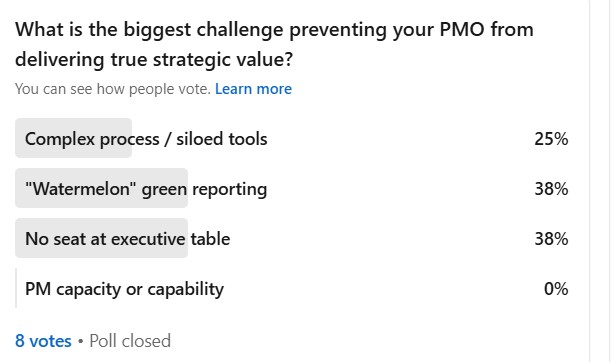
The poll showed a tie for the top challenge: 38% of respondents cited “Watermelon” green reporting, and another 38% pointed to having “No seat at executive table”. Additionally, 25% identified “Complex process / siloed tools” as their primary hurdle, while notably, a lack of “PM capacity or capability” received 0% of the vote.
These results clearly indicate that modern PMOs are not struggling with a lack of talent or project management capability; rather, they are battling systemic issues of transparency, trust, and strategic alignment. “Watermelon reporting”—a phenomenon where projects look healthy and “green” on the outside, but are secretly failing and “red” on the inside—is intrinsically linked to a PMO’s inability to secure a seat at the executive table.
To resolve these interconnected issues and evolve from a bureaucratic bottleneck into a strategic business hub, PMO leaders must take three critical steps:
1. Eradicate “Watermelon Reporting” through Objective, Intelligence-Driven Transparency To eliminate reports that hide underlying project failures, PMOs must stop relying on manual, subjective status updates. When a PMO relies on chasing spreadsheets, it inadvertently encourages project managers to paint a falsely positive picture to avoid leadership scrutiny. Instead, the PMO should implement automated performance monitoring and continuous feedback loops. By tracking objective metrics rather than subjective feelings, the PMO enforces total transparency, ensuring that underlying risks (the “red” interior) are exposed and addressed before they lead to project failure or customer dissatisfaction.
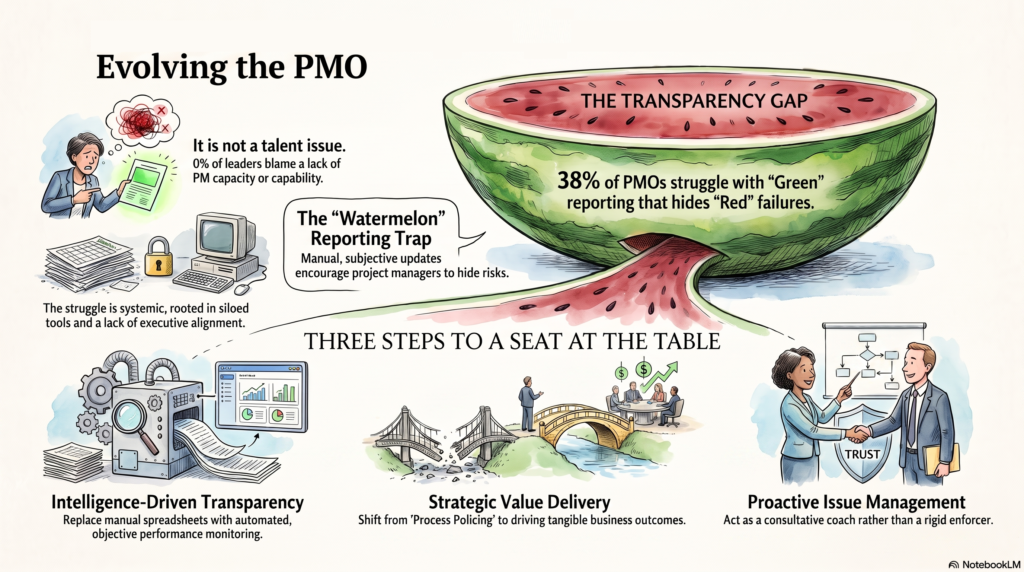
2. Shift from Process Policing to Strategic Value Delivery If a PMO is viewed as a purely administrative body obsessed with policing compliance, executives will not invite its leaders to the strategic table. To earn that seat, a PMO leader must shed low-value administrative baggage. The PMO must align its governance framework directly with the organization’s strategic goals and focus heavily on performance monitoring against customer expectations and executive vision. By doing so, leaders can prove that the PMO drives tangible business outcomes rather than just functioning as bureaucratic overhead.
3. Institute Proactive Issue Management to Build Executive Trust “Watermelon reporting” frequently occurs because project teams are afraid of the consequences of delivering bad news to leadership. The PMO can bridge this gap by acting as a consultative partner rather than a rigid enforcer. By implementing proactive risk management and robust stakeholder engagement, the PMO helps teams negotiate conflicts and solve problems early. When executives see the PMO actively coaching struggling teams and facilitating honest, transparent communication instead of hiding behind falsely “green” reports, the PMO naturally establishes itself as a trusted, indispensable advisor worthy of a seat at the executive table.
The Bottom Line The lack of strategic influence in today’s PMOs is rarely a talent issue. By abandoning manual status chasing, embracing objective transparency, and fostering proactive problem-solving, PMO leaders can overcome the “watermelon” effect and transition their offices into high-value strategic partnerships.